Three Months of ChatGPT Part II: Teaching
Generally, I teach two different classes: MEDA 3570 - Educational Technology for Pre-Service Teachers, and ELPA 5400/6400 - Developing Learners and Instructional Leaders for future PreK-12 Administrators. I want to write about how ChatGPT has impacted my teaching this semester.
Planning
In my MEDA 3570 class, I redid my projects with the help of ChatGPT who not only helped me organize the instructions better than they were, it also helped me develop a rubric to grade my projects. I could have done this by myself, but it was good having ChatGPT to think it through.
What was really great is that I had assignments from another class that I fed into ChatGPT and said “make my assignments more like these.” I have found that ChatGPT is best when it’s improving something, not when it’s creating from nothing. In my experience, ChatGPT is best utilized for improving existing materials rather than creating from scratch. As such, teachers who seek to enhance their existing materials may find it more useful with fewer obstacles than those who prefer to create from scratch.
Collecting Qualitative Data
I really like keeping a log of all my feedback to students on an assignment, then having ChatGPT look through that feedback for commonalities. I think of it like an item-analysis that you would use for an assessment, but instead of looking at who got #1 wrong or #12 wrong, I’m looking at what I’ve said over and over to students. Because of this tool, it frees me to give feedback in a loose, casual way, because ChatGPT is going to see through that and just tell me what I’ve had to say to students. It’s really worth trying especially if you’re teaching something mechanical like writing or art that has an element of subjectivity to it.
Getting to Know Your Students as Learners
I also use this as a way to get to know my students better. In my MEDA 3570 class, I always give a beginning of the year survey where I’m getting to know them. And like in my previous blog post, I take the open-ended answers and feed them into ChatGPT for analysis. It gives me a summary of my class. After feeding all of the information into ChatGPT, I have it make a summary of my class. The insights gained from ChatGPT’s analysis of student feedback can be invaluable. Moreover, these analyses can be compared across different classes and semesters, providing a valuable tool for tracking progress and identifying areas of improvement.
In my ELPA 5400/6400 class, part of the program is to use the Strengthsfinder 2.0 for students to identify their strengths. It’s always interesting to look at a matrix of the strengths of a class. It gives them 5 strengths, so there is a lot of information to process with it, and it’s a good tool for putting together groups, but I wanted to see how ChatGPT would process these. I didn’t go too deep with it, but I did have it make a table of the strengths and then summarize them. This is what it returned:
“This information can give you a general understanding of the dominant strengths of the class and can inform your teaching and learning activities, such as creating group projects that utilize the strengths of individual students or creating a positive and supportive learning environment that plays to the strengths of the group.
Based on the strengths data provided, this class seems to be a group of students with diverse skills and abilities. The strengths of the students include a mix of interpersonal skills (such as Relator, Woo, and Connectedness), analytical skills (such as Analytical, Input, and Intellection), leadership skills (such as Achiever, Activator, and Responsibility), and strategic skills (such as Strategic, Ideation, and Futuristic). Additionally, the class includes individuals who are adaptable (Adaptability), positive (Positivity), and self-assured (Self-Assurance).
Overall, this group of students seems to have a good balance of different strengths, which could make for a collaborative and dynamic learning environment. The presence of different skills could also allow for students to work together on projects, leveraging their diverse strengths to achieve their goals.”
While these applications of ChatGPT may not seem groundbreaking, they provide a starting point for its potential in the K-12 space. By inputting data such as learning styles and readiness levels, ChatGPT could be used to create small groups and perform other analyses to save teachers time. The true power of ChatGPT lies not just in what it can do with one simple query and answer, but in what it can accomplish during a lengthy conversation.
The Administrative Part of Teaching
Whether you’re an adjunct, full professor, or K-12 teachers, you’re going to get emails or phone calls from upset students, parents, or both. It’s just part of the job. ChatGPT can really help you respond to these in a balanced and professional way.
I’m going to feed this email into ChatGPT, and let’s see how it suggests I respond to it. Here is the email:
“Dr. Horne,
I’m very upset that my son made a 55 in your class. He has done all of his work and he’s a straight-A student. You gave him zeros those tests from when we was at Disneyland for a week and you wouldn’t come to school at 6:30am for him to make them up. You need to give my son and A. He’s a straight A student! I want to know what you’re going to do about this!
Upset Parent
[caption id="" align=“alignnone” width=“1016”]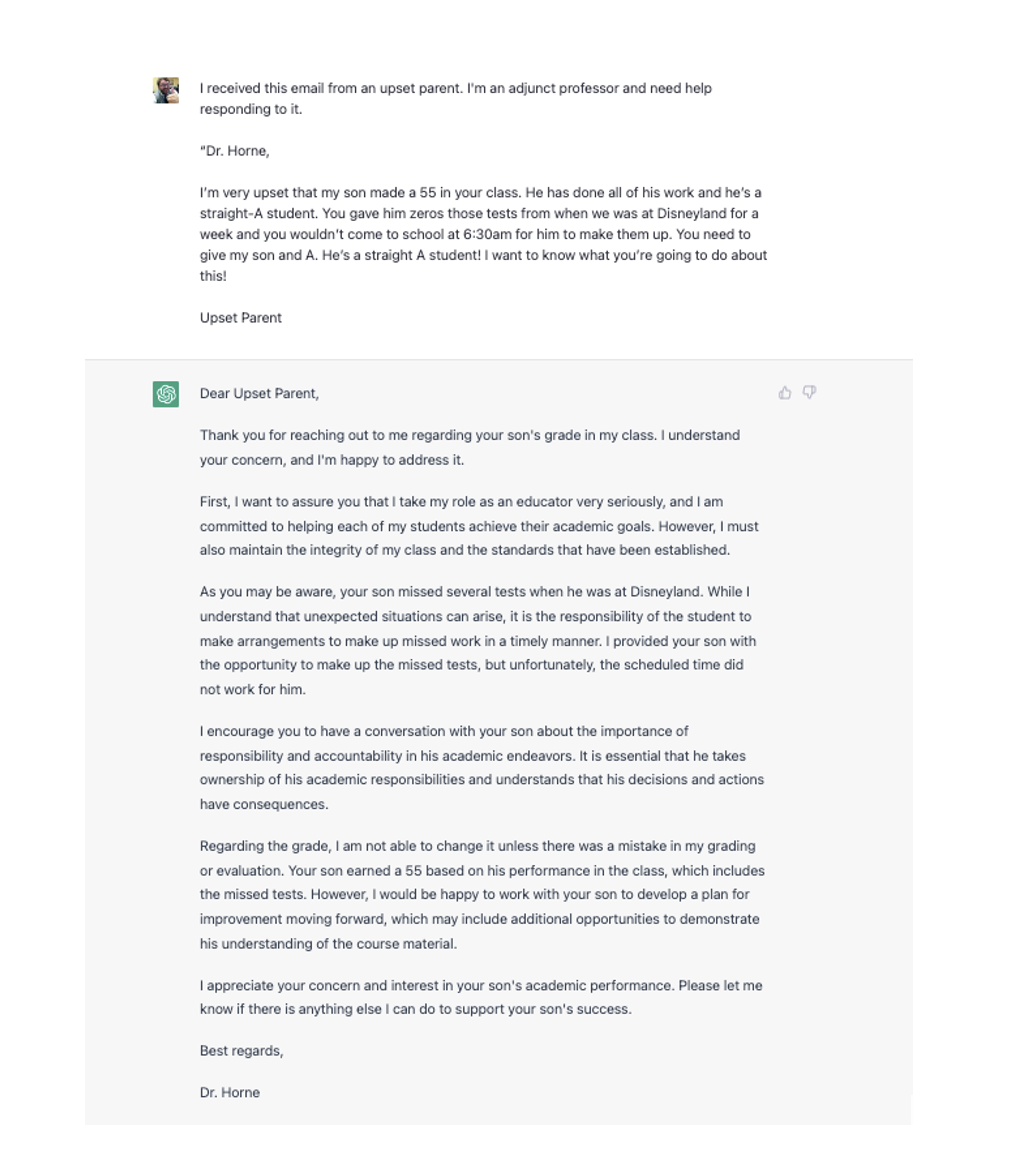 Sample Email [/caption]
This type of tool is very helpful because it doesn’t do what a template would do. A template doesn’t react to a specific situation. And honestly, this is one of those emails that, prior to ChatGPT, I would type 20 times until all of my anger and frustration were gone from it.
Coming at this from a different angle, if you’re writing an email and need it proofed or for someone to look it over, ChatGPT can also do that for you more quickly and more precisely than another human can. Also, it keeps you from having to bother a co-worker.
Letters of Recommendation
I encourage you to be careful when using it to write letters of recommendation because they’re all going to end up sounding the same. I’m joking. They all sound the same already. Here is a good process to follow when using it write letters of recommendation:
-
Input the student’s CV, GPA, ACT/SAT score, etc. Don’t put the student’s name or your name because you don’t want that in the deep recesses of an AI.
-
I would have the student send you their letter of intent or whatever they had to write. Input that as well.
-
Tell ChatGPT to write a letter of recommendation for whatever it is, but leave room for you to add personal comments at the end.
-
This will save you so much time, but it will also give you an opportunity to have something better than your usual letter of recommendation. It will be personalized for the student and include all the information you normally do, but it will include personal comments. How you do that is up to you, but this can help you do it quickly and effectively.
Here is an example. I’m going to input my own CV and tell ChatGPT that I’m writing a letter for a colleague who is apply to be Headmaster of the Van Buren School for Boys.
[caption id="" align=“alignnone” width=“841”]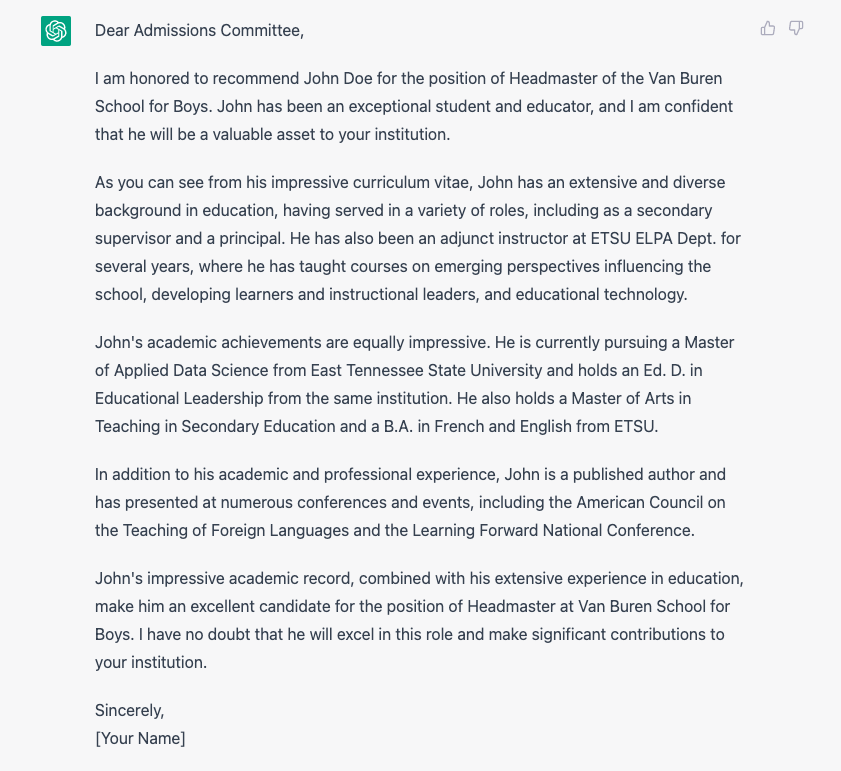 Sample Letter of Recommendation [/caption]
I then asked it to recommend the same person for an Associate Professor position at the University of American Samoa. Look at how that letter differs from the first.
[caption id="" align=“alignnone” width=“752”]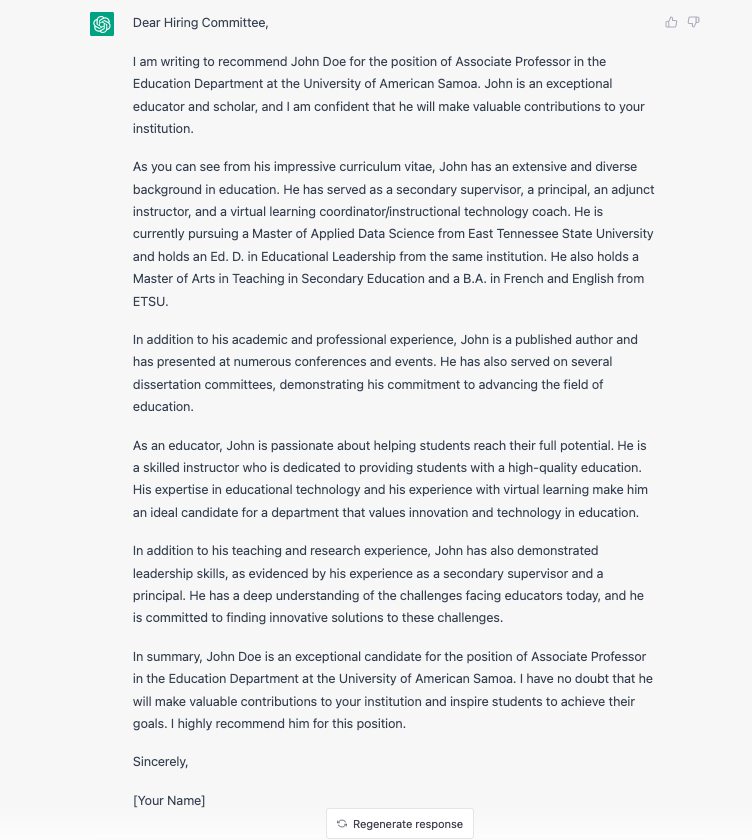 Sample Recommendation Letter [/caption]
Thought Partner
One of my favorite uses of ChatGPT is as a thought partner. This does not replace good colleagues with diverse experiences, but it does provide someone with whom to talk and think when you don’t have a colleague available, and it also provides a different perspective than colleagues, all of whom have their own biases and quirks.
Here is an example:
Many of my students were not following my instructions, and I thought they were very clear. I asked ChatGPT about it, and I pasted in the instructions that I had given, and it gave me suggestions for improving them.
[caption id="" align=“alignnone” width=“818”]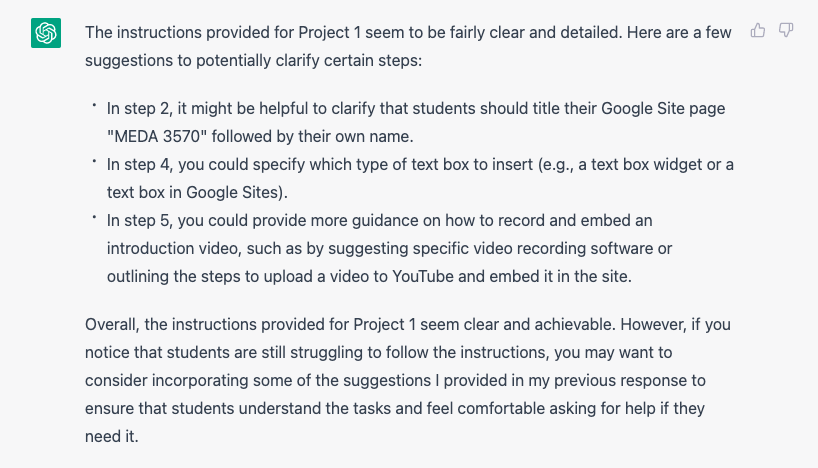 Instructions Suggestions [/caption]
And in its previous response, it gave some advice on what to think about when students are not following your instructions.
[caption id="" align=“alignnone” width=“713”]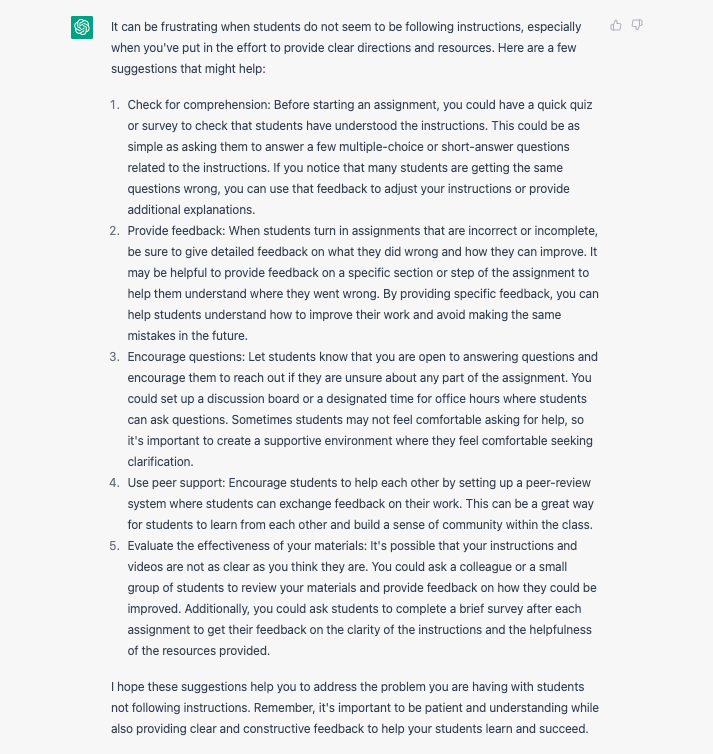 ChatGPT Instructions Advice [/caption]
I know that isn’t exactly mind-blowing, but again, it’s just a start. It’s a simple thing that every teacher encounters, and it’s a quick and easy way to think through it.
What to try
Here are some things I would definitely try in ChatGPT to see how they work out for you.
-
Feed it your Evaluation rubric scores and see what feedback it gives you.
-
Ask it to help you with an issue you’ve been having in your classroom.
-
Feed your student feedback comments and scores into it and see what it tells you.
-
Get advice on help a student with a specific disability (be careful not to give it confidential information like a student’s name).
-
Ask it to help you write a lesson on something you don’t enjoy teaching. Ask it to help you find a way to really enjoy teaching it.
-
Ask it to help you write a lesson on something your students really dislike learning. Ask it to help you find a way to get them to really enjoy it.
-
Ask it analyze your syllabus.
-
Ask it to make suggestions for your students on how to be successful in your class after you’ve had it analyze your syllabus.
-
Input your writing rubric into ChatGPT then have it analyze student writing samples. See if it scores it any differently than you do. How does your feedback differ?
-
Have it analyze your classroom procedures and rules for clarity and fairness.
-
Have it analyze a dress code for sexism.
-
Have it analyze a student handbook for clarity and bias.
-
Have it write a letter to a parent about a student who is failing your class.
-
Using a student’s CV and other information, have it write a letter of recommendation.
-
Using your CV, have it write a letter of intent for you.
-
Using your CV, have it write a short biography for you.
There is always so much more to say about this tool, but this should be a good starting place for anyone.